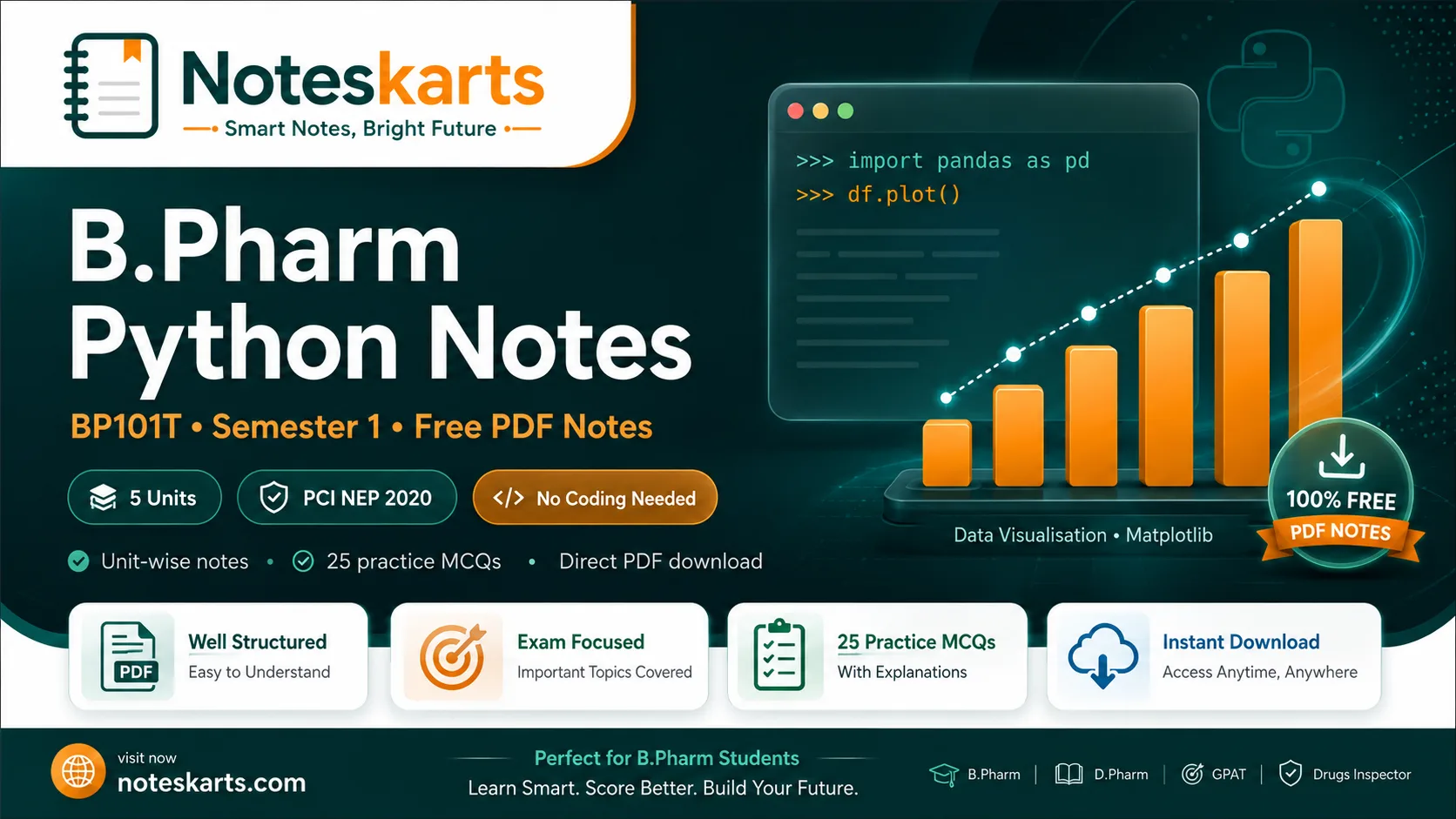
If you’re starting B.Pharm Semester 1 under the new NEP 2020 syllabus, B.Pharm Python Notes are no longer optional — they’re one of the five compulsory subjects (BP101T) every fresher now has to clear. The good news: you don’t need a coding background to get through it, and free, well-organised B.Pharm Python Notes can turn a subject that sounds intimidating into one of the easiest scoring papers in your first semester.
Why B.Pharm Python Notes Are Now Compulsory Under NEP 2020
Until the 2014 syllabus, pharmacy students never touched a programming language. That changed with the Pharmacy Council of India’s NEP 2020 update, which added Basics of Python Programming for Pharmaceutical Sciences as a 2-credit, theory-only paper in Semester 1. The subject is designed to build data-handling skills — reading ADR reports, calculating dosages, and cleaning pharma datasets — skills the profession increasingly expects. That’s exactly why searches for B.Pharm Python Notes have spiked since the 2026 batch rollout: students want a clear, pharmacy-focused explanation instead of a generic programming course.
BP101T B.Pharm Python Notes — Unit-Wise Breakdown
Good B.Pharm Python Notes should map directly to the PCI unit structure, not a random online tutorial. Here’s what the five units actually cover:
- Unit 1 — Introduction to Python Programming: installing Python, choosing an IDE (Jupyter, PyCharm, VS Code), variables, data types, and basic I/O operations
- Unit 2 — Control Structures & Functions: if-else conditions, loops, and writing modular functions for tasks like dosage or BMI calculation
- Unit 3 — Data Structures & File Handling: lists, tuples, dictionaries, NumPy arrays, and reading/writing pharmaceutical CSV datasets
- Unit 4 — Data Handling with Pandas: Series, DataFrames, cleaning missing values, and aggregating PK study or ADR data
- Unit 5 — Data Visualisation with Matplotlib: plotting concentration-time curves, ADR reporting charts, and dissolution profiles
You can download the complete unit-wise B.Pharm Python Notes PDF for BP101T here: Download the BP101T Notes.
How to Download the B.Pharm Python Notes PDF for Free
Getting your B.Pharm Python Notes shouldn’t involve five redirect links and a fake countdown timer. On Noteskarts’ BP101T page, each unit has its own ‘Download Notes’ button, so you can grab just the unit you’re revising instead of one huge, hard-to-navigate PDF.
Open the B.Pharm Python Notes page, pick your unit, and the download starts immediately — no sign-up required. If you’d rather watch than read, the same page lists video classes for each unit (marked ‘coming soon’ as they’re being recorded).
Practice With Free B.Pharm Python Notes MCQs
Reading notes only gets you halfway. The BP101T page also embeds a 25-question rapid MCQ set pulled straight from these B.Pharm Python Notes, covering pandas syntax, loop logic, and basic data types — questions shuffle into a new order every time you reload, so you can reuse it as many times as you like before your internal exams. Pair that with Noteskarts Labs, which generates unlimited exam-format MCQs on any pharmacy topic in English or Hindi using pandas-style data handling under the hood, and exports straight to Word or CSV.
Tips to Master B.Pharm Python Notes Faster
A few habits make these B.Pharm Python Notes stick faster than passive reading:
- Type every example yourself instead of just reading the code block — muscle memory matters more than it feels like it does
- Connect each pandas or NumPy function to a real pharma example (ADR frequency table, dosage calculator) rather than memorising syntax in isolation
- Attempt the 25-question MCQ set after every unit, not just before the exam
- Keep a one-page cheat sheet of functions (read_csv(), head(), groupby()) as you go through the B.Pharm Python Notes, instead of rebuilding it the night before the paper
Python in B.Pharm Semester 1 is new, but it isn’t difficult — most students who struggle with it simply started with notes that weren’t written for pharmacy students. Download the complete B.Pharm Python Notes for BP101T, work through the five units in order, and use the built-in MCQs to check yourself before the exam. For the rest of Semester 1 — Human Anatomy, Pharmaceutics, Pharma Analysis and Communication Skills — check the full B.Pharm new syllabus 2026 hub on Noteskarts for unit-wise notes on every subject.
Download Notes https://noteskarts.com/b-pharm-1st-sem-python-notes-pdf-new-syllabus-2026-bp101t/
