The FPGEE exam is the single biggest hurdle between an internationally trained pharmacist and a US pharmacy licence, and most guides treat it like a topic list. A topic list is not a plan.
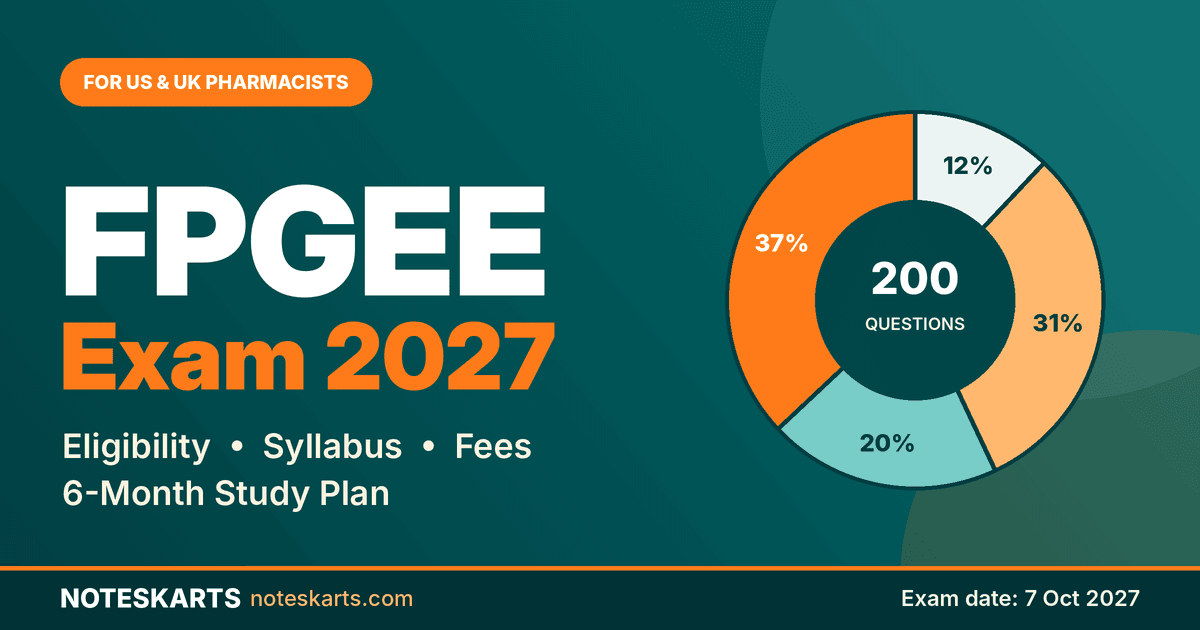
A plan tells you how many hours each subject deserves, and the FPGEE exam tells you that itself. Pharmacy Practice and Clinical Sciences is 37% of the exam. Foundational Biomedical Sciences is 12%. If you are spending your best hours revising anatomy and biochemistry the way you did at university, you are putting them into the smallest section.
This guide is written for pharmacists in the United States and the United Kingdom. It covers FPGEE exam eligibility, the official 2027 syllabus blueprint, current fees, honest pass rates, the English-language rules, and a 6-month study plan built around a full-time job. The next sitting is on 7 October 2027, so you have time to do this properly.
Last verified: 2 November 2026, against NABP sources.
In this guide
FPGEE exam quick facts for 2027
| Item | Detail |
|---|---|
| Exam date | 7 October 2027 (held once per year) |
| Where | Pearson VUE test sites in the continental USA only |
| Questions | 200 scored questions, computerised, fixed form |
| Exam time | 4.5 hours (5.5 hours total seat time) |
| Passing score | 75 (scaled score, not a percentage) |
| Attempt limit | 5 attempts, lifetime |
| Results | About 8 weeks, in your NABP e-Profile |
| English test | TOEFL iBT or OET for Pharmacy (one is enough) |
| Pass rate (2025) | 92.6% first-time takers, 90.5% all takers |
Source: NABP FPGEE exam page
FPGEE exam eligibility: check this before you spend anything
FPGEE exam eligibility is decided by the Foreign Pharmacy Graduate Equivalency Commission (FPGEC), which is part of NABP. The three core requirements all have to be met. There is no partial credit.
- Graduate from a recognised or accredited school of pharmacy in a non-US country or jurisdiction.
- Meet the programme-length rule. If you graduated before 1 January 2003, the programme must be at least four years. If you graduated on or after 1 January 2003, it must be at least five years.
- Hold the qualification that is required for licensure or authorisation to practise as a pharmacist in the country where it was awarded.
The five-year rule is where people get caught. ECE, the credential evaluator used by NABP, states that the official length of the programme is set by the country or school, and that prior studies do not lengthen it. An ECE evaluation is the only reliable way to find out where your own qualification stands. Not a forum, not a consultant, and not this article. The criteria are on the ECE page for NABP evaluations.
If you are coming from India, see our guide on how to become a pharmacist in the USA from India.
If you trained or are registered in the UK
This is the question UK readers ask most, so here is the careful answer. A UK MPharm is a four-year degree, followed historically by a one-year pre-registration training period before you could join the General Pharmaceutical Council (GPhC) register. UK initial education has been changing, and how a given route is counted under the five-year rule depends on when you graduated and what your degree contained.
NABP and ECE do not publish a UK-specific ruling on their public pages. So do not assume either way. Get an ECE evaluation of your own transcript and registration evidence first. It costs a fraction of the FPGEC fees, and the FPGEC fees are non-refundable.
English-language requirement and two deadlines that catch people
- You must pass an English test before you are accepted for the FPGEE exam. NABP accepts the TOEFL iBT or the Occupational English Test (OET) for Pharmacy. Only one is needed. OET scores are accepted for exams taken from 11 January 2027, so it is now a real option for 2027 candidates. TOEFL MyBest Scores can be used for the 2027 exam if submitted on or after 1 November 2026. International test sites are not accepted by the FPGEC for this requirement, so check where you are allowed to sit it.
- FPGEC applications are valid for two years. After acceptance you have two years to pass the FPGEE exam. If the period lapses you need a new application and new fees.
The official FPGEE exam syllabus: domain weights and what they mean for your hours
NABP publishes the exact weight of every content domain in its FPGEE Content Outline. It is the most useful document in your preparation, and it is free. These are the weights across the 200 scored questions.
Domain weights (200 scored questions)
| Content domain | Weight | Questions | Suggested study hours (of 400) |
|---|---|---|---|
| 1. Foundational Biomedical Sciences | 12% | ~24 | ~48 |
| 2. Pharmaceutical Sciences | 31% | ~62 | ~124 |
| 3. Social, Behavioral & Administrative Sciences | 20% | ~40 | ~80 |
| 4. Pharmacy Practice & Clinical Sciences | 37% | ~74 | ~148 |
Weights and question counts are NABP’s. The study-hours column is our recommendation, split in proportion to the weights.
Read the bottom two rows together. Domains 3 and 4 make up 57% of the FPGEE exam, which is 114 questions. These are the areas where graduates trained outside the US are usually least prepared, because they cover US health systems, US pharmacy law, pharmacoeconomics and clinical decision-making in the US context.
Domain 1 covers anatomy, physiology, biochemistry, microbiology and immunology. It is the area most graduates know best, and it is worth only 24 questions. Most FPGEE exam failures are not knowledge failures. They are allocation failures.
What each domain covers
The outline is NABP’s copyrighted document, so here is a plain-language summary. Download the official PDF and work from that.
Domain 1, Foundational Biomedical Sciences (12%). Anatomy and physiology, biochemistry, medical microbiology, immunology and the pathophysiological basis of disease. Familiar territory from your degree.
Domain 2, Pharmaceutical Sciences (31%). Pharmaceutical calculations, medicinal chemistry, pharmacology and toxicology, pharmaceutics and biopharmaceutics, pharmacokinetics and compounding. US compounding standards such as USP chapters 795, 797 and 800 are worth a dedicated week if the outline lists them for your sitting.
Domain 3, Social, Behavioral & Administrative Sciences (20%). US pharmacy law and ethics, how US health care is organised and financed, pharmacoeconomics, public health, practice management, communication, biostatistics and research methods. Even experienced UK pharmacists should treat this as new material.
Domain 4, Pharmacy Practice & Clinical Sciences (37%). Clinical pathophysiology applied to treatment, patient assessment, patient-care decision making, patient safety, disease prevention, evidence-based practice and self-care. It is the biggest domain and the most clinical.
The pattern to notice: Domains 2 and 4 together are 68% of the FPGEE exam. Both reward applying knowledge rather than reciting it, so practise with questions, not only with notes.
FPGEE pass rate: the honest numbers
NABP publishes five-year results in its FPGEE pass rate document. Here they are.
| Administration year | First-time takers | All takers |
|---|---|---|
| 2021 | 77.5% | 67.8% |
| 2022 | 90.2% | 84.7% |
| 2023 | 89.3% | 86.3% |
| 2024 | 93.1% | 91.1% |
| 2025 | 92.6% | 90.5% |
Source: NABP, FPGEE passing rates for 2021–2025 graduates (published 23 December 2025).
Two takeaways. First, the FPGEE pass rate is high and has held above 89% since 2022, at 92.6% for first-time takers in 2025. This is not the impossible exam some forums describe. Prepared candidates pass.
Second, look at the gap between first-time and all takers. In 2021 it was nearly 10 points. In 2025 it was about 2. Repeat takers now pass at almost the same rate as first-timers, which is a good sign if you have to retake. It is also a reminder that the exam is rarely what stops people. The eligibility check, the paperwork and the once-a-year schedule are.
FPGEE exam fees: what we can confirm
NABP’s public pages confirm that the FPGEC application includes a $100 administrative fee and a separate document-evaluation fee, and that the application fee is not refunded. The exam purchase fee is paid later, once you have been accepted. Fee amounts change, so always confirm them in the current FPGEC Candidate Application Bulletin before paying.
| Cost | Amount | Notes |
|---|---|---|
| FPGEC administrative fee | $100 | Non-refundable |
| Document evaluation fee | See current Bulletin | Part of the FPGEC application. Not refunded |
| FPGEE exam purchase fee | See current Bulletin | Refundable only if cancelled with both Pearson and NABP at least 5 business days before the appointment |
| English test (TOEFL iBT or OET) | Set by ETS / OET | TOEFL has a 15% discount with code NABPTOEFL |
| ECE credential evaluation | Set by ECE | Paid directly to ECE. Do this first |
Do not forget the costs outside the application. The FPGEE exam is held only in the continental US, so UK candidates should budget for flights, accommodation and travel authorisation, and check the current US entry rules for their situation well before booking. A realistic first-attempt budget including travel often lands somewhere around $4,000 to $6,000. Treat that as an estimate and rebuild it from the Bulletin figures and the current exchange rate.
FPGEE exam dates 2027 and one change many guides miss
| Date | What happens |
|---|---|
| 10 May 2027 | Registration (exam purchase) opens for accepted applicants |
| 7 Sept 2027 | Deadline to submit a name change |
| 20 Sept 2027 | Deadline to purchase the FPGEE (required to receive your Authorization to Test) |
| 30 Sept 2027 | Deadline to schedule or cancel your appointment at Pearson |
| 7 Oct 2027 | FPGEE exam day |
| About 8 weeks later | Scores appear in your NABP e-Profile |
Source: NABP FPGEE exam page
The change: as of 1 April 2026, candidates no longer receive an FPGEE Identification Card (FIC). Older guides still tell you to bring one. That advice is obsolete, so check the current Bulletin for what you need on test day.
A time-zone trap for UK readers. NABP deadlines run on US Central Time, 9 AM to 5 PM. In September that is roughly 3 PM to 11 PM UK time. Do not leave the purchase to the final evening.
FPGEE exam study plan: 6 months for people with jobs
This plan assumes about 15 hours a week: two hours on weekday evenings and five across the weekend. Six months gives roughly 400 hours. Working backwards from 7 October 2027, you would start in early April 2027. Hours follow the blueprint weights, not your comfort zone.
Months 1 and 2: Domain 2, Pharmaceutical Sciences (about 124 hours)
- Start here, not with biology. It is 31% of the exam and your training transfers well, which means fast wins and momentum.
- Do pharmaceutical calculations first. Drill until you are accurate under time pressure, not just accurate.
- Then pharmacology, medicinal chemistry, pharmacokinetics and biopharmaceutics.
- Set aside a week for US compounding standards, which most non-US graduates have not studied.
Month 3: Domain 3, Social, Behavioral & Administrative (about 80 hours)
- Treat it as a new subject, because for most candidates it is. US pharmacy law, health care financing, pharmacoeconomics and biostatistics.
- You cannot reason your way to these answers. You either know how US health care is organised and paid for, or you do not.
- Biostatistics and research methods are worth real marks and can be learned in a few weeks.
Months 4 and 5: Domain 4, Pharmacy Practice & Clinical Sciences (about 148 hours)
- The biggest domain at 37%, around 74 questions. Give it your sharpest hours.
- Go disease by disease: pathophysiology, then guideline-based therapy, then monitoring.
- Use US clinical practice guidelines. UK practice such as NICE or BNF conventions can differ from US guidance, and the exam asks about the US.
- Fit Domain 1 (about 48 hours) alongside as revision. You know most of it, and 24 questions does not justify a dedicated month.
Month 6: full-length practice and repair
- Take the Pre-FPGEE, NABP’s official practice exam. Use it to learn the question format and gauge your level, not as a textbook.
- Sit at least three full 4.5-hour timed papers. 200 questions in 4.5 hours is about 81 seconds per question, and stamina is a skill.
- Rebuild weak areas from your results, weighted by the blueprint. A gap in Domain 4 costs roughly three times what the same gap in Domain 1 does.
The rule that decides whether the plan works
Score every study hour against the blueprint. Before you open a book, ask which domain it serves and what percentage that domain is worth. If you cannot answer, you are reading, not studying. That is the difference between the 92.6% who pass and the rest.
FPGEE exam FAQs
What is the FPGEE exam syllabus for 2027?
The FPGEE exam covers four domains: Foundational Biomedical Sciences (12%), Pharmaceutical Sciences (31%), Social, Behavioral and Administrative Sciences (20%), and Pharmacy Practice and Clinical Sciences (37%). NABP’s content outline is free to download.
When is the FPGEE exam in 2027?
7 October 2027. Registration opens on 10 May 2027 and the purchase deadline is 20 September 2027. It is held once a year.
How many questions are on the FPGEE exam?
200 scored questions in a computerised, fixed-form exam. You get 4.5 hours, and total seat time is 5.5 hours.
What is the FPGEE passing score?
75. This is a scaled score, not a percentage, so answering 75% of questions correctly does not guarantee a pass.
What is the FPGEE pass rate?
In 2025 it was 92.6% for first-time takers and 90.5% for all takers, according to NABP’s five-year data.
Can UK pharmacists take the FPGEE exam?
Eligibility depends on your qualification, not your nationality. NABP requires a degree from a non-US pharmacy school that meets its programme-length rule, so get an ECE evaluation of your UK qualification first.
Which English test do I need for the FPGEE exam?
Either the TOEFL iBT or the OET for Pharmacy. One is enough, and it must be passed before you are accepted for the exam.
Can I retake the FPGEE exam?
Yes, up to 5 attempts in total. You must pass within the 2-year validity of your FPGEC application, otherwise you need a new application.
Do I still need an FPGEE Identification Card?
No. As of 1 April 2026, candidates no longer receive an FIC. Check the current Bulletin for test-day ID requirements.
How long should I study for the FPGEE exam?
Six months at about 15 hours a week (roughly 400 hours) is realistic for a working pharmacist. Split those hours by blueprint weight.
Your next step
Download two free documents today, before you buy a single review book:
- The FPGEE Content Outline. Print it and tick topics off as you go.
- The FPGEC Candidate Application Bulletin, the only authority on fees, deadlines and test-day rules.
Then get your ECE evaluation started, book your English test, and build your hour plan from the domain weights. Everything else is detail.
Dates, weights, pass rates and policies in this guide were checked against NABP sources on 2 November 2026. NABP updates requirements regularly, so confirm everything against the current Bulletin before paying any fee. This article is general information, not legal or immigration advice.
