Last updated: November 2026 | By Noteskarts Team | Facts verified against NABP data
NAPLEX preparation is the difference between passing the pharmacist licensure exam on your first attempt and losing months to a retake. The good news for 2026: pass rates have jumped, the blueprint is public, and studying to the exam’s own weighting gives you the best chance.
Quick Answer: how to prepare for the NAPLEX. Study 8-12 weeks, weighted by the official blueprint. Person-Centered Assessment & Treatment Planning is 40% of the exam, and clinical content overall is about 90%. Practise with rationale-based questions, then sit full-length 6-hour mock exams. The 2025 first-time pass rate for ACPE graduates was 86.8%.
This guide covers everything you need for NAPLEX preparation in 2026: exam format, content blueprint, pass rates, scoring, eligibility, a week-by-week study plan and the mistakes that cost candidates a retake.
NAPLEX 2026: quick facts
| Item | Detail |
|---|---|
| Full name | North American Pharmacist Licensure Examination |
| Run by | NABP (National Association of Boards of Pharmacy) |
| Questions | 225 (200 scored + 25 unscored experimental) |
| Duration | 6 hours (two optional 10-minute breaks) |
| Scoring | Pass / Fail (no numerical score shown) |
| Attempts | Max 5 lifetime, up to 3 per year |
| Eligibility | ACPE-accredited PharmD or FPGEC certification |
| Results | Usually within 14 business days (NABP e-Profile) |
| Fee | About $575 (confirm current fee on NABP) |
What is the NAPLEX and how is the exam structured?
The NAPLEX is the main US pharmacist licensing exam, run by NABP. You must pass it, plus a state law exam such as the MPJE, to become a licensed pharmacist.
The exam has 225 questions over six hours. 200 are scored and 25 are unscored experimental questions mixed in. You cannot tell which is which, so treat every question as if it counts. Questions test applied clinical judgement, not just recall, so effective NAPLEX preparation must be practice-heavy.
What is on the NAPLEX blueprint? Study to the weights
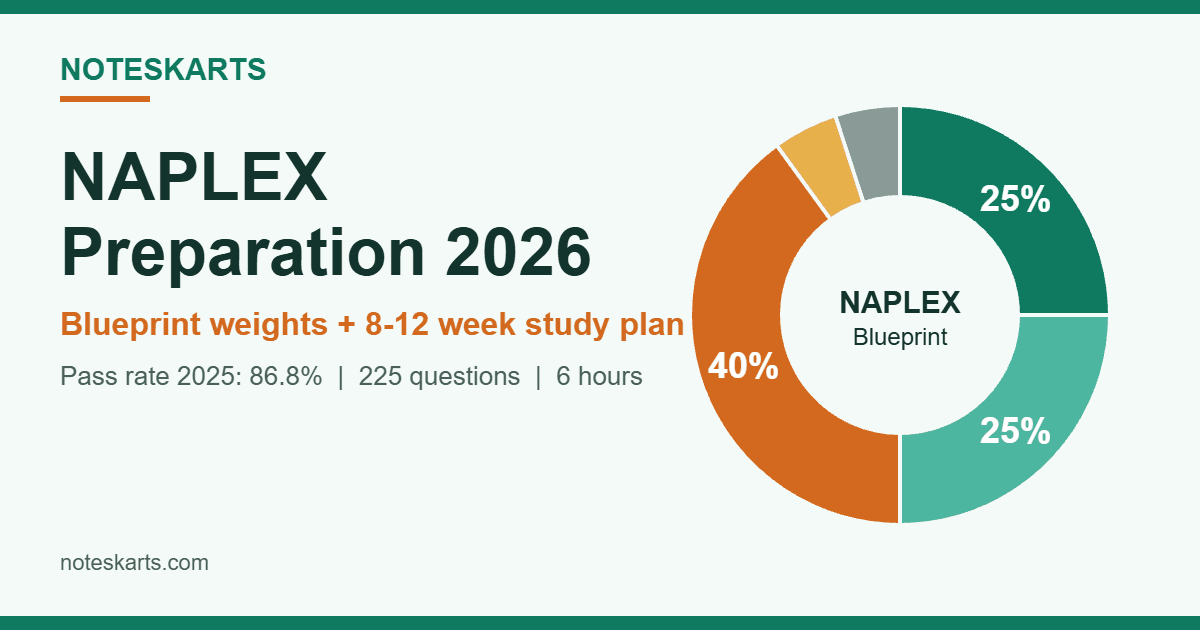
Short answer: 40% of the exam is Person-Centered Assessment & Treatment Planning. NABP publishes exactly how much each content area is worth, which makes the blueprint the backbone of any NAPLEX preparation plan. The current blueprint (effective 1 May 2025) continues for 2026 candidates.
| Content area | Weight | Approx. scored questions |
|---|---|---|
| 1. Foundational Knowledge for Pharmacy Practice | 25% | about 50 |
| 2. The Medication Use Process | 25% | about 50 |
| 3. Person-Centered Assessment & Treatment Planning | 40% | about 80 |
| 4. Professional Practice | 5% | about 10 |
| 5. Pharmacy Management & Leadership | 5% | about 10 |
Read the weights carefully. Area 3 alone is 40%. Add Areas 1 and 2 and clinical and medication-use content make up 90% of your score. Areas 4 and 5 together are only 10%.
Takeaway: put your best study hours into therapeutics, patient assessment and the medication-use process. Do not over-invest in management topics that carry one question in ten.
NAPLEX pass rate: what it means for your NAPLEX preparation
Short answer: the 2025 first-time pass rate for ACPE graduates was 86.8%, up from 75.9% in 2024. That should reassure anyone starting their NAPLEX preparation, and it shows that structured NAPLEX preparation works.
| Year (ACPE graduates) | First-time pass | All attempts |
|---|---|---|
| 2023 | 77.5% | 75.7% |
| 2024 | 75.9% | 72.2% |
| 2025 | 86.8% | 85.6% |
Source: NABP NAPLEX pass-rate data. Verified November 2026.
The pattern is clear: prepared first-time candidates pass at a high rate. The exam rewards structured preparation and punishes cramming or waiting too long after graduation.
What is the NAPLEX passing score? How scoring works in 2026
Short answer: there is no number to hit. The NAPLEX is Pass or Fail. Since 2021 most candidates see only Pass or Fail. Internally the pass threshold is a scaled cut point of 75, which is why older guides say “score 75”. Those guides are out of date.
If you fail, your report shows your relative performance across the five content areas, so you know where to focus for a retake. Results usually appear in your NABP e-Profile within 14 business days (some states deliver them differently).
NAPLEX eligibility, attempts and retakes before you start
Confirm you are eligible before you invest weeks in NAPLEX preparation.
- Eligibility: graduate of an ACPE-accredited PharmD program, or FPGEC certification for foreign-trained pharmacists, plus your state board’s requirements.
- Attempts: maximum 5 lifetime attempts, up to 3 per year.
- Waiting periods: 45 days after a failed attempt; after 3 failures within 12 months, 12 months from your first attempt.
Foreign-trained pharmacists: complete FPGEC certification first. Read our FPGEE exam guide and how to become a pharmacist in the USA from India before you start NAPLEX preparation.
NAPLEX preparation study plan: 8-12 weeks, week by week
Short answer: allocate time by blueprint weight, then build six-hour stamina. Here is a realistic structure for NAPLEX preparation and NAPLEX study over 8-12 weeks.
Weeks 1-4: build the clinical core (Areas 1-3)
This is the foundation of NAPLEX preparation.
- Start with therapeutics and patient assessment. This is where 40%+ of the exam lives.
- Review the medication-use process: dispensing, calculations, safety and monitoring.
- Practise pharmacy calculations daily. They are guaranteed marks if your method is solid.
Weeks 5-8: practice questions and weak areas
- Shift to high-volume practice questions. Learning from rationales is where real gains happen.
- Target weak areas revealed by your practice scores, weighted by the blueprint.
- Cover Areas 4 and 5 briefly: enough for 10% of the exam, no more.
Weeks 9-12: full-length exams and stamina
- Sit full-length timed practice exams. Six hours is a marathon, so train for it.
- Review every missed question and lock in your pacing: about 200 scored questions means steady, not rushed.
- Taper in the final days. Arrive rested, not cramming. Good NAPLEX preparation ends with a calm week, not a panic.
Common NAPLEX preparation mistakes to avoid
Most retakes trace back to a few avoidable NAPLEX preparation errors:
- Studying all five areas equally instead of following the blueprint weights.
- Only reading review books and skipping timed practice questions.
- Never sitting a full six-hour mock, then running out of energy on exam day.
- Ignoring pharmacy calculations until the last week.
- Waiting many months after graduation before testing.
Best NAPLEX preparation resources
Most successful candidates build their NAPLEX preparation from three things: a comprehensive review book for structure, a large question bank with detailed rationales for applied practice, and full-length practice exams for stamina and timing.
Choose resources that match the current blueprint and include plenty of case-based, patient-centered questions, because that is what 40% of the exam looks like. Quality of practice matters more than the number of books you own, and that is true for every stage of NAPLEX preparation.
Frequently asked questions about NAPLEX preparation
How many questions are on the NAPLEX in 2026?
The NAPLEX has 225 questions: 200 scored and 25 unscored experimental, over 6 hours with two optional 10-minute breaks. You cannot tell which are experimental.
What is the NAPLEX passing score?
The NAPLEX is reported as Pass or Fail with no numerical score shown. The internal pass threshold is a scaled cut point of 75.
What is the NAPLEX pass rate?
For ACPE graduates, the first-time pass rate was 86.8% in 2025, up from 75.9% in 2024.
How long should I study for the NAPLEX?
Most candidates plan 8 to 12 weeks of focused NAPLEX preparation, weighted by the blueprint, with full-length mock exams in the final weeks.
What should NAPLEX preparation focus on?
Follow the blueprint. Person-Centered Assessment & Treatment Planning is 40%, and with Foundational Knowledge and the Medication Use Process, clinical content is about 90%. Prioritise therapeutics, assessment and calculations.
How many times can I take the NAPLEX?
Maximum 5 lifetime attempts, up to 3 per year. After a failure you wait 45 days; after 3 failures within 12 months, you wait 12 months from your first attempt.
Can foreign pharmacists take the NAPLEX?
Yes, after FPGEC certification and meeting the state board’s requirements. Complete FPGEC first, then prepare for the NAPLEX and the state law exam.
How do I start NAPLEX preparation?
Download the official NABP content outline, build a schedule around the blueprint weights, and begin NAPLEX preparation with therapeutics and calculations.
Do I need to pass a law exam too?
Yes. Most states also require a jurisprudence exam such as the MPJE. Check your state board of pharmacy.
The bottom line: how to start your NAPLEX preparation
Strong NAPLEX preparation in 2026 comes down to one principle: study to the blueprint. Put your best hours into therapeutics, patient assessment and the medication-use process, nearly 90% of the exam. Practise with rationale-rich questions and build six-hour stamina with full-length tests. With pass rates now high for prepared first-time candidates, a focused plan is your best investment.
Next step: download the official NABP content outline, build your schedule around the domain weights, and start early.
Note: this article is general exam-preparation guidance, not official NABP advice. Exam rules, fees and pass rates change. Confirm current details on nabp.pharmacy and with your state board of pharmacy.
Sources and official links
- NABP: NAPLEX (official exam information)
- NABP: National Association of Boards of Pharmacy
- ACPE: Accreditation Council for Pharmacy Education
Format, blueprint, pass rates and scoring verified against public sources in November 2026.
Related reading on Noteskarts
- FPGEE Exam: Eligibility, Syllabus & Study Plan
- How to Become a Pharmacist in the US and UK 2026
- How to Become a Pharmacist in USA from India: Complete Guide
- Pharmacist Salary in the US and UK 2026
