Last updated: November 2026 | By Noteskarts Team | Figures from public sources, verified November 2026
A medical coding career has become one of the most popular job switches for pharmacy, nursing, and life-science graduates in India, and it is easy to see why. It is a desk-based, work-from-home-friendly role in healthcare, pays well with experience, and you do not need to be a doctor or pharmacist to do it.
Quick Answer: is a medical coding career worth it in India? Yes, for the right person with realistic expectations. Fresher pay is modest (about ₹1.8–3.6 LPA), but it rises to ₹7–12+ LPA with experience. Pharmacy, nursing and life-science graduates can enter after a short course and the CPC certification (100 questions, 4 hours, open-book, about $425).
This guide gives you an honest, detailed look at a medical coding career in India for 2026: what the job is, who can apply, the CPC certification, real salary ranges, scope, and how to start.
Medical coding career at a glance (2026)
| Item | Detail |
|---|---|
| What it is | Converting diagnoses and procedures into standard billing codes |
| Code systems | ICD-10-CM, CPT, HCPCS Level II |
| Who can enter | Pharmacy, nursing, life-science, allied-health graduates |
| Key certification | CPC from AAPC (100 Q, 4 hrs, 70% to pass, open-book) |
| Exam fee | About $425 (confirm on AAPC) |
| Fresher salary | About ₹1.8–3.6 LPA |
| Senior salary | About ₹7–12+ LPA |
| Work style | Desk-based, often remote or hybrid |
Why a medical coding career is a smart switch in 2026
If you have a healthcare or science degree but do not want hospital shifts or retail pharmacy work, medical coding is a natural fit:
- Huge demand. US and global healthcare billing is heavily outsourced to India, so coders are hired in large numbers.
- Work-from-home friendly. Many coding roles are remote or hybrid.
- Open to many degrees, not just pharmacy. Life sciences, nursing, BPT, BDS, and more can enter.
- Clear growth. You can move from coder to auditor, team lead, and trainer, with salary rising sharply.
One honest reality check: Medical coding is a good career, but fresher salaries are modest, the CPC exam is not cheap (around $425), and certification alone does not guarantee a job. Skills, accuracy, and practice do. This guide gives the real picture, not the hype some course adverts sell.
What is medical coding?
Medical coding is the process of converting a patient’s diagnoses, treatments, procedures, and services into standardised codes used for billing and insurance claims. Coders read medical records and assign codes from three main systems:
- ICD-10-CM: diagnosis codes (what the patient has).
- CPT: procedure codes (what was done).
- HCPCS Level II: codes for supplies, drugs, and services.
Accurate coding ensures hospitals and clinics get paid correctly and that insurance claims are compliant. It is detail-focused, rules-driven work, ideal for people who like accuracy and structure.
Who can start a medical coding career in India?
Short answer: most healthcare and life-science graduates can. One of the biggest advantages of a medical coding career is how open it is. You usually need a background that gives you medical knowledge, but not a specific pharmacy degree. Common eligible backgrounds include:
- B.Pharm, M.Pharm, Pharm.D, D.Pharm
- B.Sc / M.Sc in life sciences, biology, biotechnology, microbiology, biochemistry
- Nursing (B.Sc / GNM), BPT, BDS, BAMS, BHMS and other paramedical or allied health degrees
- Life-science and some general graduates, depending on the employer
Freshers can enter, usually after a short coding course and certification. This accessibility is exactly why a medical coding career is popular with science graduates who want an industry desk job. If you are also weighing other pharmacy paths, read our guide on how to become a pharmacist in the USA from India and the RRB Pharmacist syllabus 2026 for government jobs.
CPC certification: the key to a medical coding career
The most recognised credential in India and globally is the Certified Professional Coder (CPC) from AAPC (the American Academy of Professional Coders). It proves you can assign ICD-10-CM, CPT, and HCPCS codes accurately.
CPC exam facts
| Item | Detail |
|---|---|
| Questions | 100 multiple-choice questions |
| Duration | 4 hours |
| Passing score | 70% (at least 70 correct) |
| Format | Open book (approved code books allowed) |
| Exam fee | About $425 (confirm current fee on AAPC) |
| Code books | ICD-10-CM, CPT (AMA Professional), HCPCS Level II |
| Upkeep | AAPC membership + 36 CEUs every 2 years |
CPC vs CPC-A (apprentice)
If you pass the exam but do not yet have the required work experience, you receive CPC-A (apprentice) status. Once you document the needed experience (often two years, which training or a practicum can partly offset), the “A” is removed and you become a full CPC. Other credentials you may see include CCS (AHIMA), COC, and CIC.
Medical coding salary in India 2026
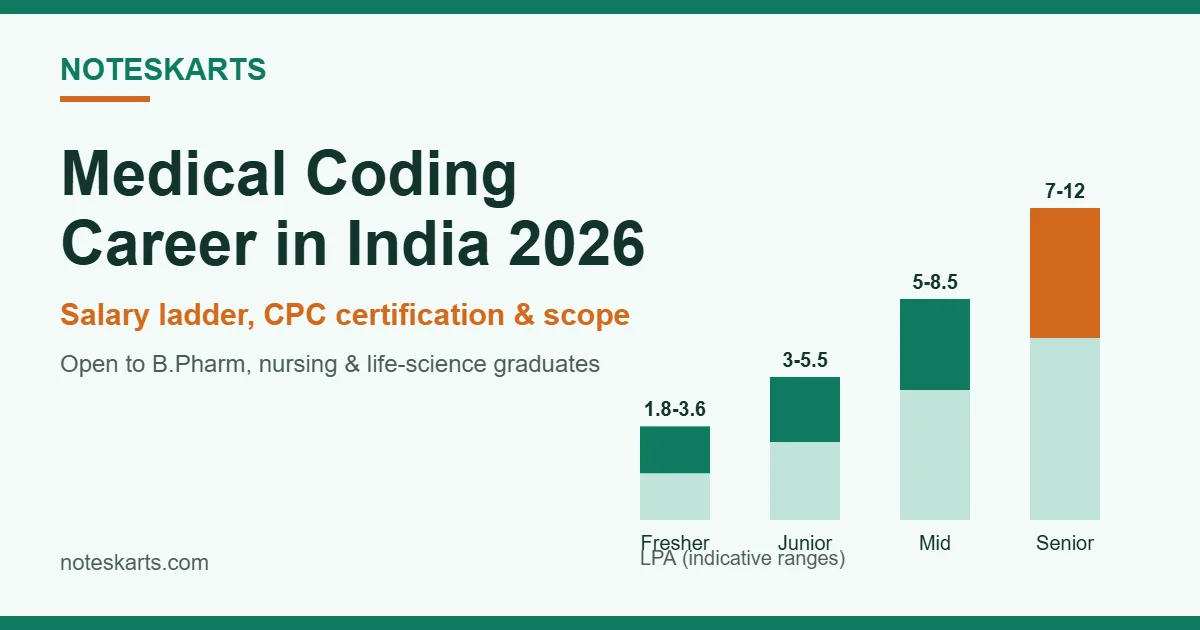
Short answer: about ₹1.8–3.6 LPA for freshers, rising to ₹7–12+ LPA for seniors. Pay starts modest and rises well with experience and certification. These are indicative ranges from public sources; actual pay varies by city, employer, and skill.
| Experience | Approx. monthly | Approx. annual |
|---|---|---|
| Fresher (0–1 yr) | ₹15,000 – ₹30,000 | ₹1.8 – ₹3.6 LPA |
| Junior (1–3 yrs) | ₹25,000 – ₹45,000 | ₹3.0 – ₹5.5 LPA |
| Mid-level (3–5 yrs) | ₹40,000 – ₹70,000 | ₹5.0 – ₹8.5 LPA |
| Senior (5+ yrs) | ₹60,000 – ₹1,00,000+ | ₹7.0 – ₹12.0+ LPA |
Does CPC certification increase a medical coding salary?
Yes, noticeably. Public data suggests CPC-certified coders earn roughly 20–50% more than non-certified coders. Freshers without certification may start around ₹10,000–18,000 per month, while CPC-certified freshers often start around ₹15,000–30,000 per month.
Salary by city, employer, and remote work
- Cities: Bangalore, Hyderabad, and Chennai typically pay the most, followed by Kochi and other hubs.
- Employer: medical-billing companies and MNC healthcare firms pay more than small hospitals; freelancing varies.
- Remote and international roles can pay significantly more, often ₹50,000–₹1,50,000 per month for experienced, specialised coders.
Career roles and growth in a medical coding career
A medical coding career has a clear ladder:
| Role | Typical stage |
|---|---|
| Medical Coder | Entry (after certification) |
| Senior Medical Coder | 2–4 years |
| Coding Auditor / QA | 4–6 years |
| Team Lead / Coding Manager | 6+ years |
| Coding Trainer / Specialist | Experienced, specialised |
Specialising, for example in surgery, radiology, inpatient (IP-DRG), or risk-adjustment (HCC) coding, raises pay and demand further.
Scope and future of medical coding in India
The outlook is strong, driven by a few durable trends:
- Healthcare outsourcing: the US and other countries send huge volumes of coding work to India, creating steady hiring.
- Compliance and insurance growth: accurate coding is legally essential, so the work never disappears.
- Remote work: coding is one of the most work-from-home-friendly healthcare careers.
A fair note on technology: AI tools are starting to assist with coding, but they still need trained human coders to review, correct, and handle complex or compliance-sensitive cases. The role is evolving, not vanishing. Coders who keep upskilling stay in demand.
How to start a medical coding career: step by step
- Confirm you are eligible. A healthcare, science, or allied-health background helps most.
- Learn the basics: medical terminology, anatomy, and the ICD-10-CM, CPT, and HCPCS systems.
- Take a focused CPC-prep course if you need structured training and practice (choose carefully).
- Pass the CPC exam to earn CPC (or CPC-A if you lack experience).
- Build a sharp resume and apply to billing companies, MNCs, and remote roles in the major hubs.
- Start as a coder, gain accuracy and speed, then specialise and climb the ladder.
Common mistakes when starting a medical coding career
- Paying for an expensive course that promises a guaranteed job. No course can promise that.
- Skipping practice. Accuracy and speed matter more than the certificate alone.
- Ignoring code-book navigation, which is essential in the open-book CPC exam.
- Expecting a high first salary instead of planning for steady growth.
Is a medical coding career worth it?
Honestly: yes, for the right person with realistic expectations. Entry pay is modest and the first job takes effort and certification. But demand is strong, the work is stable, remote-friendly, and open to many degrees, and salaries rise well with experience and specialisation into the ₹7–12+ LPA range and beyond.
For a pharmacy or science graduate who wants a desk-based healthcare career without hospital shifts, a medical coding career is one of the most realistic, rewarding switches available in 2026.
Frequently asked questions about a medical coding career
What is a medical coding career?
A medical coding career involves converting patient diagnoses, procedures and services into standardised codes (ICD-10-CM, CPT, HCPCS) used for billing and insurance claims. It is a detail-focused, desk-based healthcare job, often work-from-home friendly.
What is the salary of a medical coder in India?
Freshers earn around ₹1.8–3.6 LPA, juniors ₹3–5.5 LPA, mid-level ₹5–8.5 LPA, and seniors ₹7–12+ LPA. CPC-certified coders typically earn 20–50% more than non-certified ones, and remote or international roles can pay far more.
Who can become a medical coder in India?
Pharmacy (B.Pharm, D.Pharm, Pharm.D), nursing, life-science, BPT, BDS, BAMS, BHMS and other allied-health graduates are commonly eligible. Freshers can enter after a short course and CPC certification.
What is CPC certification?
CPC (Certified Professional Coder) is AAPC’s globally recognised credential. The exam has 100 questions, runs 4 hours, is open-book, needs 70% to pass, and costs around $425. Without experience, you start as CPC-A (apprentice).
Is medical coding a good career in 2026?
Yes, for someone wanting a stable, remote-friendly healthcare desk job with clear growth. Entry pay is modest and certification costs money, but demand is strong thanks to healthcare outsourcing, and pay rises well with experience.
Will AI replace medical coders?
Not entirely. AI tools assist with coding, but trained human coders are still needed to review, correct, and handle complex, compliance-sensitive cases. Coders who keep upskilling remain in demand.
How do I start a medical coding career as a fresher?
Learn medical terminology and the ICD-10-CM, CPT and HCPCS systems, pass the CPC exam, then apply to billing companies and remote roles. Start as a coder and build accuracy and speed.
The bottom line: your medical coding career starts here
A medical coding career is one of the smartest, most accessible job switches a pharmacy or science graduate can make in 2026: stable, remote-friendly, and open to many degrees. Go in with realistic expectations: start modest, earn your CPC certification, build real accuracy, and climb steadily. The demand is strong, and so is the long-term pay.
Confirm your eligibility, learn the code systems, get certified, and apply with persistence. That is how a career switch becomes a career.
Note: this article is general career guidance, not a job guarantee or an endorsement of any course or employer. Salaries and fees vary and change. Research providers and roles independently, and confirm CPC details on AAPC’s official site before paying.
Sources and official links
CPC exam details and India salary ranges were verified against public sources in November 2026 and are indicative only. Pay, fees, and demand change. Confirm current figures before deciding. No course or certificate guarantees a job.
