Last updated: November 2026 | By Noteskarts Team | Facts verified against NABP data
The MPJE exam is the pharmacy law test that stands between a PharmD graduate and a licence to practise. It trips up more people than they expect, because it tests law, not clinical knowledge, and it is different in every state.
Quick Answer: what is the MPJE exam? The MPJE is the US pharmacy law exam run by NABP. It has 120 questions (100 scored), takes 2.5 hours, is adaptive with no going back, and needs a scaled score of 75 to pass. It is state-specific, so you study each state’s law separately. California uses the CPJE instead.
This guide explains the MPJE exam in full for 2026: what it is, how it is state-specific, the content blueprint, format, scoring, fees, and the study tips that actually help you pass.
MPJE exam 2026: quick facts
| Item | Detail |
|---|---|
| Full name | Multistate Pharmacy Jurisprudence Examination |
| Run by | NABP |
| Questions | 120 (100 scored + 20 unscored pretest) |
| Must answer | At least 107 for the exam to be scored |
| Duration | 2.5 hours (computer-based, adaptive) |
| Passing score | 75 (scaled 0–100) |
| Fee | About $250 ($150 exam + $100 application) |
| Attempts | Up to 5 per state; 30-day wait after a fail |
| Eligibility | ACPE PharmD or FPGEC + state requirements |
What is the MPJE exam and why does state matter?
The MPJE is the law exam for US pharmacist licensure, administered by NABP. Alongside the NAPLEX, you must pass it to become a licensed pharmacist.
The single most important thing to understand: the MPJE exam is STATE-SPECIFIC. Each state’s exam focuses on that state’s pharmacy laws (combined with federal law). If you want to be licensed in two states, you usually take a separate MPJE for each one.
This is why you cannot simply “pass the MPJE” once and practise anywhere. Your MPJE preparation must target the exact state you are seeking licensure in.
Which states use the MPJE exam (and which don’t)?
The MPJE is required in most US states plus Washington DC and Guam, over 40 jurisdictions. It is NOT used in these states:
- Alaska, Arkansas, Idaho, Michigan, and Vermont: these have their own arrangements.
- California: uses the CPJE (California Practice Standards and Jurisprudence Examination) instead.
If you plan to practise in California, prepare for the CPJE, not the MPJE. For every other MPJE state, study that state’s specific laws.
What is on the MPJE exam blueprint?
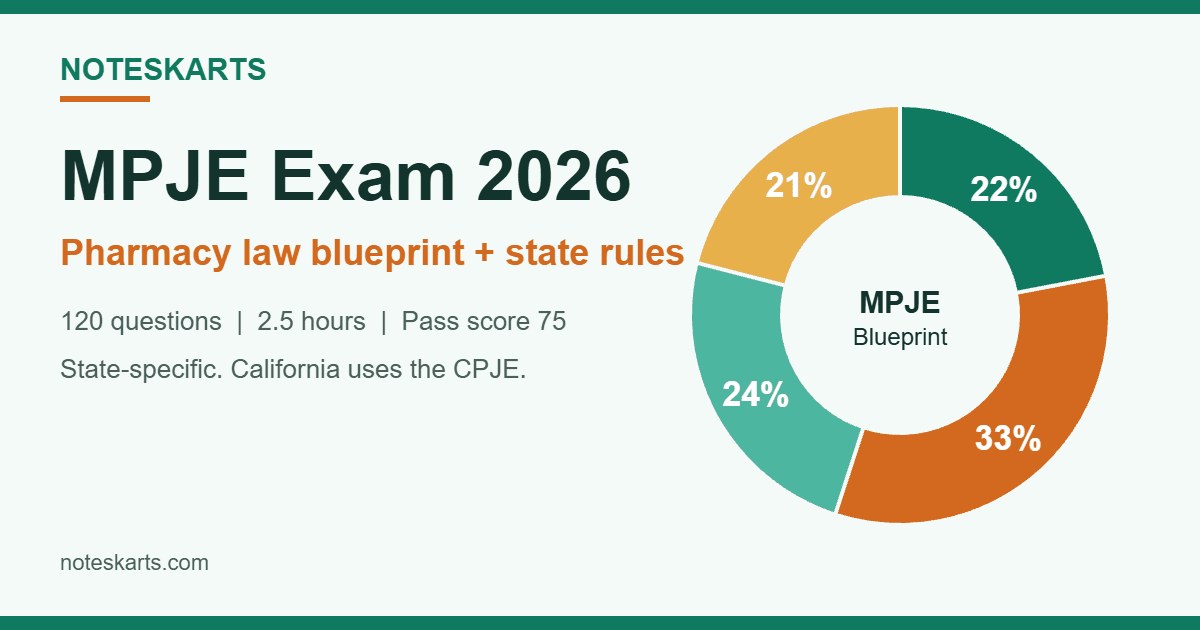
Short answer: four content areas, with Pharmacist Practice the largest at about 33%. NABP publishes the content areas and their approximate weights. Studying to these weights is the smartest way to prepare for the MPJE exam.
| Content area | Approx. weight |
|---|---|
| Area 1: Licensure & Personnel | about 22% |
| Area 2: Pharmacist Practice | about 33% |
| Area 3: Dispensing Requirements | about 24% |
| Area 4: Pharmacy Operations | about 21% |
Area 2 (Pharmacist Practice) is the largest at about a third of the exam, followed closely by dispensing requirements and operations. Licensure and personnel rules round it out. In practice, that means controlled-substance rules, dispensing law, recordkeeping, and practice regulations deserve the bulk of your study time.
MPJE exam format: adaptive and unforgiving
The MPJE exam is computer-based and adaptive, which changes how you should approach it:
- Question types: multiple-choice (one best answer), multiple-response (select all that apply), and K-type (combinations).
- Adaptive: the exam adjusts difficulty based on your answers. Getting questions right generally leads to harder ones.
- No going back: you cannot skip a question or change an earlier answer. Decide, commit, move on.
- Minimum answered: you must answer at least 107 of the 120 questions for your exam to be scored.
Because you cannot revisit answers, pacing and careful first-read comprehension matter more than on many other exams.
MPJE exam scoring, fees and attempts
- Passing score: 75 on a scaled score from 0 to 100.
- Fee: around $250 per attempt ($150 exam fee + $100 application fee). A re-sit is typically $150 plus the application fee.
- Attempts: up to 5 per jurisdiction (unless your state board sets a different limit), with a 30-day wait after a failed attempt.
Compared with the NAPLEX, the MPJE exam is shorter and cheaper, but do not underestimate it. Pass rates vary by state, and careless reading causes many failures. See our NAPLEX preparation 2026 guide for the clinical exam.
How to pass the MPJE exam: study tips that work
Short answer: study your own state’s law, read every word, and practise scenario questions. Pharmacy law is a different skill from clinical pharmacy. These tips come up again and again from people who passed first time:
- Study your specific state’s laws. Do not rely on generic national material alone. State law is the heart of the exam.
- When state and federal law differ, the stricter rule usually governs. Know both and apply the more restrictive one.
- Read every word. Questions are often worded as traps. Answer the question actually asked, and watch for trigger words like “except”, “not”, or specific time limits.
- Expect scenario-based questions, not simple recall. Practise applying rules to cases.
- Master controlled-substance rules, recordkeeping, and dispensing requirements. These are high-yield, heavily tested areas.
- Use a reputable state-specific study guide and practice questions, and arrive early with two valid IDs.
Common MPJE exam mistakes to avoid
- Studying national law only and ignoring your state’s rules.
- Rushing the first read and missing words like “except” or “not”.
- Treating it like the NAPLEX. This is a law exam, so memorising clinical facts will not help.
- Not practising scenario questions under timed conditions.
The MPJE exam for foreign-trained pharmacists
If you trained outside the US, you must complete FPGEC certification before you are eligible for the MPJE exam, along with meeting your chosen state’s requirements such as internship hours. The law content is entirely US-based, so budget extra study time for US and state pharmacy law, which will be new to you.
See our FPGEE exam guide and how to become a pharmacist in the USA from India for the full route.
Frequently asked questions about the MPJE exam
What is the MPJE exam?
The MPJE (Multistate Pharmacy Jurisprudence Examination) is the US pharmacy law exam required for pharmacist licensure in most states. It tests federal and state pharmacy law, and you must pass it along with the NAPLEX to become licensed.
What is the passing score for the MPJE exam?
The passing score is 75 on a scaled score from 0 to 100. The exam has 120 questions (100 scored, 20 unscored pretest), and you must answer at least 107 for it to be scored.
Is the MPJE exam the same in every state?
No. The MPJE is state-specific. Each state’s exam focuses on its own pharmacy laws plus federal law, so you generally take a separate MPJE for each state where you want to be licensed.
Which states do not use the MPJE?
Alaska, Arkansas, Idaho, Michigan, and Vermont do not use the MPJE, and California uses the CPJE instead. If you plan to practise in California, prepare for the CPJE.
How much does the MPJE exam cost?
About $250 per attempt, typically a $150 exam fee plus a $100 application fee. A re-sit is usually $150 plus the application fee.
How many times can I take the MPJE exam?
Up to 5 attempts per jurisdiction, unless your state board sets a different limit. You must wait 30 days after a failed attempt before retaking it.
How long should I study for the MPJE exam?
Many candidates plan a few focused weeks on their target state’s law, weighted by the blueprint, with plenty of scenario-based practice questions. Allow more time if US pharmacy law is new to you.
Do foreign-trained pharmacists need to take the MPJE exam?
Yes, in most states. You must complete FPGEC certification first and meet your chosen state’s requirements, then pass the NAPLEX and the state’s MPJE.
The bottom line: how to pass the MPJE exam
Passing the MPJE exam comes down to one principle: study the specific state’s law, carefully. It is a shorter, cheaper exam than the NAPLEX, but its traps, adaptive format, and state-by-state rules catch unprepared candidates. Focus on your target state’s controlled-substance, dispensing, and practice laws, read every question like a lawyer, and practise scenario questions until the rules are second nature.
Pick your state, get its specific law guide, study to the blueprint, and read carefully. That is how first-time passes happen.
Note: this article is general exam-preparation guidance, not legal or official NABP advice. Exam rules, fees, and state requirements change. Confirm current details on the official NABP website and with your state board of pharmacy before relying on them.
Sources and official links
MPJE format, blueprint, scoring, fees, and state use were verified against public sources in November 2026. Figures and state rules change. Confirm current details on nabp.pharmacy and with your state board before making decisions.