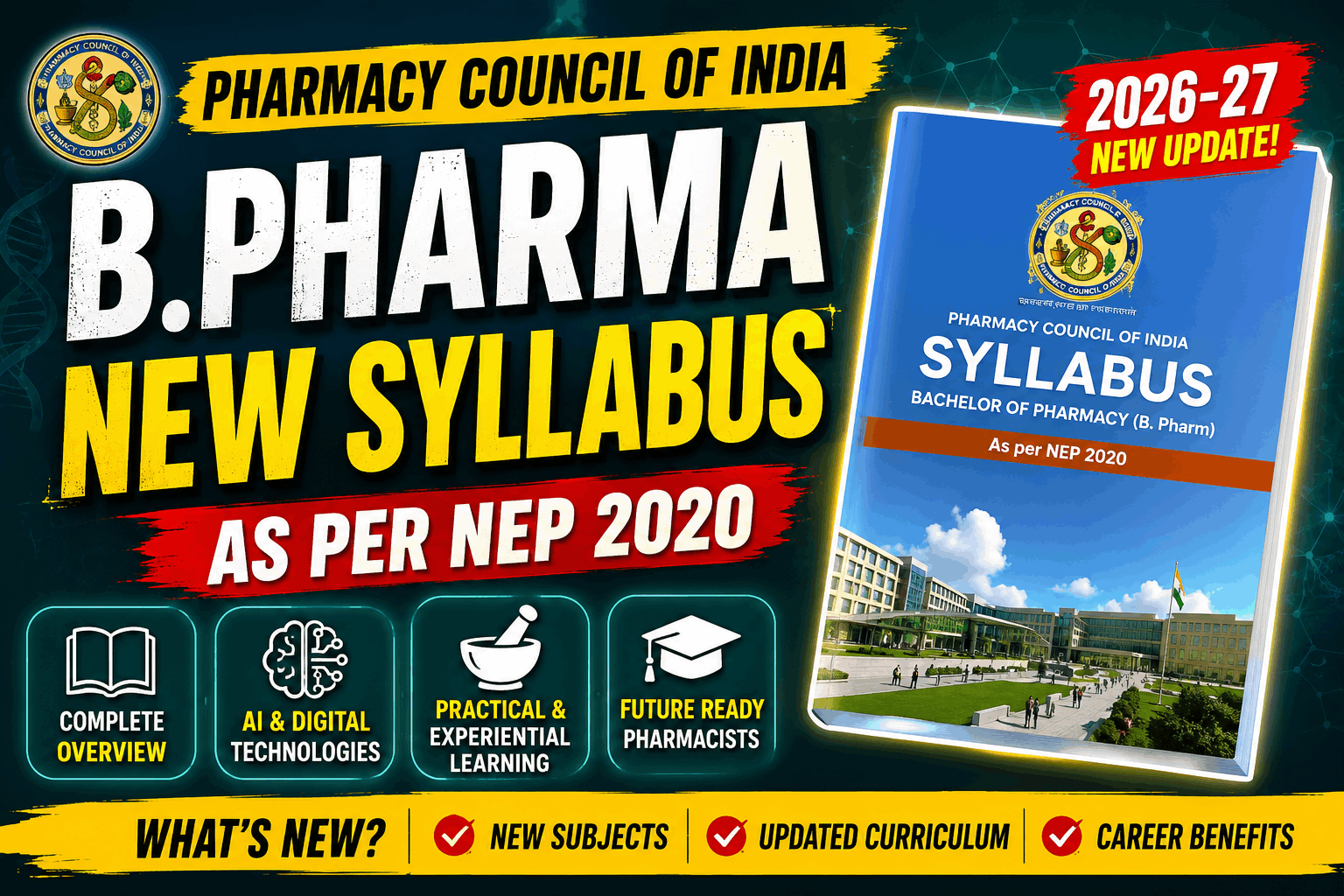
B.Pharm 2nd Semester Notes 2026: new syllabus
B.Pharm 2nd semester notes for the new PCI syllabus: six theory subjects, five practicals and one skill elective, worth 26 credits. Pick a subject card to see its five units, then use the scheme table and FAQs below.
Descriptive statistics, probability and distributions, sampling and inference, correlation and regression, plus Python-based case studies.
Enzymology, biomolecules and bioenergetics, carbohydrate, lipid, amino acid and protein metabolism, nucleic acids and genetic information transfer.
Nervous, gastrointestinal, respiratory, urinary, endocrine and reproductive systems, with pathophysiology and cancer built in.
Pharmaceutical Organic Chemistry
Alkanes and cycloalkanes, alkenes, alkyl halides, benzene and its derivatives, and carbonyl compounds.
Pharmacognosy and Phytochemistry
Metabolic pathways and biogenesis, primary and secondary metabolites, extraction methods, isolation and identification techniques.
Physical Pharmaceutics
Solubility and buffers, interfacial phenomena, colloidal and coarse dispersions, rheology and micromeritics.
B.Pharm 2nd semester scheme at a glance
This B.Pharm 2nd semester notes scheme table lists every course in the semester with its official PCI code, hours per week and credits. Every practical needs a minimum of 12 experiments.
| Code | Course | Type | Hours/week | Credits |
|---|---|---|---|---|
| BP201T | Applied Biostatistics and Data Analytics for Pharmaceutical Sciences | Theory | 2 | 2 |
| BP202T | Biochemistry | Theory | 3 | 3 |
| BP203T | Human Anatomy, Physiology and Pathophysiology II | Theory | 4 | 4 |
| BP204T | Pharmaceutical Organic Chemistry | Theory | 4 | 4 |
| BP205T | Pharmacognosy and Phytochemistry | Theory | 4 | 4 |
| BP206T | Physical Pharmaceutics | Theory | 3 | 3 |
| BP207P | Biochemistry | Practical | 3 | 1 |
| BP208P | Human Anatomy, Physiology and Pathophysiology II | Practical | 3 | 1 |
| BP209P | Pharmaceutical Organic Chemistry | Practical | 3 | 1 |
| BP210P | Pharmacognosy and Phytochemistry | Practical | 3 | 1 |
| BP211P | Physical Pharmaceutics | Practical | 3 | 1 |
| BP212P | Skill elective: Communication Skills, Mental Well-Being, Stress and Conflict Management, or Fundamentals of Computer Operations (choose one) | Elective | 2 | 1 |
| Total, Semester 2 | 37 | 26 | ||
What is new in B.Pharm 2nd semester notes and syllabus
Subjects that changed
- Pathophysiology now sits inside Human Anatomy, Physiology and Pathophysiology II.
- Biostatistics becomes Applied Biostatistics and Data Analytics, with Python case studies in Unit V.
- Pharmacognosy and Phytochemistry and Physical Pharmaceutics both start in Semester 2.
What this means for you
- Keep your practical record up to date from week one, since each practical has at least 12 experiments.
- Pick your BP212P skill elective early, because only one can be chosen.
- Keep these B.Pharm 2nd semester notes handy for exams, and revise Semester 1 first with our B.Pharm 1st semester notes.
B.Pharm 2nd semester practicals
Our B.Pharm 2nd semester notes cover theory and practical work together. Practicals carry 1 credit each and run 3 hours a week. Biochemistry covers protein and carbohydrate tests, urine analysis and blood glucose, cholesterol and urea estimation. The anatomy practical covers system models, reflex and vital-capacity tests, and CPR training. Organic chemistry covers systematic analysis of unknown compounds and crystallization. Pharmacognosy covers crude drug microscopy and isolation of caffeine, hesperidin and pectin. Physical pharmaceutics covers surface tension, viscosity, micromeritics and buffer capacity.
B.Pharm 2nd semester notes FAQs
There are six theory subjects (BP201T to BP206T), five practical courses (BP207P to BP211P) and one skill elective (BP212P). Together they carry 26 credits and 37 hours a week.
Applied Biostatistics and Data Analytics, Biochemistry, Human Anatomy, Physiology and Pathophysiology II, Pharmaceutical Organic Chemistry, Pharmacognosy and Phytochemistry, and Physical Pharmaceutics, each with a matching practical except biostatistics.
Choose exactly one of three skill courses: Communication Skills, Mental Well-Being, Stress and Conflict Management, or Fundamentals of Computer Operations. It is a 1 credit course.
No. Pathophysiology is merged into Human Anatomy, Physiology and Pathophysiology II (BP203T), so you study the body system and its common disorders together.
Yes, in a practical way. Unit V of Applied Biostatistics and Data Analytics uses Python for case-based statistical analysis of healthcare and pharmaceutical data.
The revised NEP 2020 B.Pharm syllabus applies to students admitted from the 2026-27 session. Earlier batches continue on the syllabus they joined with.
Unit-wise B.Pharm 2nd semester notes are being added subject by subject. Join the Noteskarts WhatsApp or Telegram channel, or open the Noteskarts Prime app, to get each subject as soon as it is published.
More ways to study with Noteskarts
Noteskarts Prime
Full-syllabus video lectures, printable unit-wise notes and revision material for every semester, made for B.Pharm and D.Pharm students.
Noteskarts Labs
AI-powered study tools such as the MCQ Lab, built to help you practise faster and revise smarter.
Bookmark this page for B.Pharm 2nd semester notes updates, because we add each subject as soon as it is ready. Subject names, codes and credits follow the Pharmacy Council of India B.Pharm syllabus revised under NEP 2020. Looking for all eight semesters? See the B.Pharm new syllabus notes hub.