Last updated: November 2026 | By Noteskarts Team | Figures from public sources, verified November 2026
A clinical data management career sits at the exact point where pharma meets data, which makes it one of the most future-proof career switches a pharmacy or science graduate can make in India. If you like accuracy, logic, and a little technology, this field rewards you well.
Quick Answer: is a clinical data management career worth it in India? Yes. Freshers start around ₹2.5–4.5 LPA and can reach ₹15–25+ LPA as leads or principals. The biggest pay jumps go to people who add SAS/R programming and CDISC skills. Pharmacy, life-science and computer-science graduates can enter, usually as a Clinical Data Associate with GCP certification.
This guide gives you an honest, detailed look at a clinical data management career in India for 2026: what the job involves, who can enter, real salary ranges by level, the tools and skills employers want, and how to start.
Clinical data management career at a glance (2026)
| Item | Detail |
|---|---|
| What it is | Cleaning and managing clinical-trial data for regulators |
| Key tools | EDC (Medidata Rave, Oracle Clinical), CDISC (SDTM, ADaM), SAS/R |
| Who can enter | Pharmacy, life-science, computer-science graduates |
| Entry roles | Clinical Data Associate, Data Entry Specialist |
| Must-have | GCP certification for most roles |
| Fresher salary | About ₹2.5–4.5 LPA |
| Lead salary | About ₹15–25+ LPA |
| Work style | Office-based, data- and process-driven |
Why a clinical data management career is worth it
Clinical data management (CDM) is where clinical trials turn messy raw data into clean, reliable datasets regulators can trust. For a science graduate who wants an office-based industry role, it is a strong choice:
- Growing demand. The industry is reportedly growing 12–15% a year, with hundreds of active openings.
- A data and technology edge. CDM rewards skills like EDC systems, CDISC standards, and SAS/R programming, and hybrid data-plus-programming roles pay a premium.
- Open to many degrees. Pharmacy, life sciences, and even computer-science graduates with clinical training.
- Clear progression from associate to manager, lead, and head of data management.
One honest reality check: CDM is a good, future-proof career, but fresher salaries are modest and the biggest pay jumps come to those who add programming (SAS/R) and CDISC skills. A course helps, but certification alone does not guarantee a job. Skills and accuracy do. This guide gives the real ladder, not the hype.
What is clinical data management?
Clinical data management is the process of handling the data generated in clinical trials, from collection and cleaning to validation, consolidation, and final delivery. The goal is simple but critical: make sure trial data is accurate, complete, and reliable enough for regulatory submission.
In practice, CDM professionals design and manage the databases that capture trial data, check it for errors and inconsistencies, raise and resolve queries with trial sites, and prepare clean datasets for statistical analysis. It is detail-focused, process-driven work that sits close to clinical research and biostatistics.
Who can start a clinical data management career?
Short answer: pharmacy, life-science and computer-science graduates. CDM is open to a range of graduates, one reason it is such a popular switch. Common eligible backgrounds:
- Pharmacy: B.Pharm, M.Pharm, Pharm.D
- Life sciences: B.Sc / M.Sc in biology, biotechnology, microbiology, biochemistry
- Computer science graduates with clinical training (especially for data-programming roles)
GCP (Good Clinical Practice) certification is required for most positions, and freshers usually enter as a Clinical Data Associate or Data Entry Specialist. Those who add programming skills can aim straight for higher-paying hybrid roles.
Clinical data management roles and career ladder
| Level | Typical roles |
|---|---|
| Entry | Clinical Data Associate, Data Entry Specialist |
| Junior | Clinical Data Coordinator, entry Data Programmer |
| Mid | Clinical Data Analyst, Clinical Data Manager |
| Senior | Senior / Lead Clinical Data Manager |
| Leadership | Head of Data Management |
Clinical data management salary in India 2026
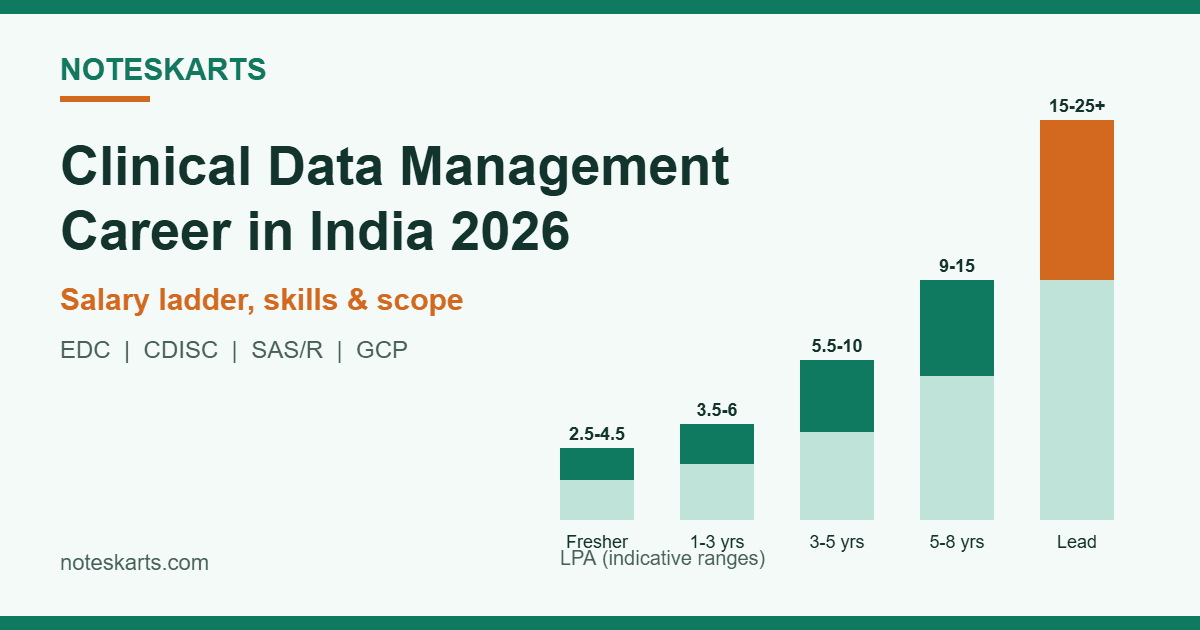
Short answer: about ₹2.5–4.5 LPA for freshers, rising to ₹15–25+ LPA for leads. Pay starts modest and climbs steadily, with programming-heavy roles at the top. These are indicative ranges from public sources; actual pay varies by company and skill set.
| Experience | Salary (per year) | Average |
|---|---|---|
| Fresher (0–1 yr) | ₹2.5 – ₹4.5 LPA | about ₹3.5 LPA |
| Early career (1–3 yrs) | ₹3.5 – ₹6.0 LPA | about ₹4.5 LPA |
| Mid-level / CDM (3–5 yrs) | ₹5.5 – ₹10.0 LPA | about ₹7.0 LPA |
| Senior (5–8 yrs) | ₹9.0 – ₹15.0 LPA | about ₹12.2 LPA |
| Lead / Principal (8+ yrs) | ₹15.0 – ₹25.0+ LPA | about ₹18.0 LPA |
The main CDM hubs are Bangalore, Hyderabad, Mumbai, Pune, and Chennai, and global CROs typically pay at the higher end.
Skills and tools for a clinical data management career
- EDC (Electronic Data Capture) systems such as Medidata Rave and Oracle Clinical.
- CDISC standards, including SDTM and ADaM, the data formats regulators expect.
- SAS or R programming, a genuine premium skill that unlocks hybrid, higher-paying roles.
- GCP certification, and ideally CCDM (Certified Clinical Data Manager) or vendor EDC certification.
- Attention to detail, query management, and therapeutic-area knowledge (for example oncology, rare diseases).
Scope, recruiters, and future of clinical data management in India
The outlook is strong. India is a major global hub for clinical-trial data work, and the field is reportedly growing 12–15% a year with hundreds of live openings.
Top recruiters include IQVIA, ICON, Syneos Health, Parexel, Fortrea, PPD (Thermo Fisher), Veeda Clinical Research, Siro Clinpharm, TCS, and Cognizant. These CROs and IT-healthcare firms hire CDM talent in large numbers across the major hubs.
A fair note on AI: automation and AI are speeding up data cleaning and query detection, but trained CDM professionals are still needed to design databases, judge complex data issues, and ensure regulatory-grade quality. The role is shifting toward higher-skill, programming-aware work, which is exactly where the pay is.
How to start a clinical data management career: step by step
- Confirm eligibility. A pharmacy, life-science, or computer-science background works well.
- Learn the fundamentals: the clinical-trial data lifecycle, GCP, and CDISC (SDTM/ADaM) basics.
- Get hands-on with an EDC system and, ideally, start learning SAS or R. This is your edge.
- Earn GCP certification (and later CCDM) if it helps your profile; choose any course carefully.
- Apply to CROs and healthcare-IT firms as a Clinical Data Associate, then grow toward manager and lead roles.
Common mistakes when starting a clinical data management career
- Paying for a course that promises a guaranteed job. No course can promise that.
- Ignoring programming. Without SAS/R and CDISC, the pay ceiling is lower.
- Skipping GCP certification, which most employers expect.
- Applying only to a few big CROs instead of also trying healthcare-IT firms and mid-size CROs.
Clinical data management vs pharmacovigilance, regulatory affairs and medical coding
All are popular pharma career switches open to similar graduates. In short:
- Clinical data management: data- and (optionally) programming-focused; future-proof; strong ceiling for SAS/CDISC skills.
- Regulatory affairs: highest overall salary ceiling; document- and compliance-heavy. See our regulatory affairs career guide.
- Pharmacovigilance: drug-safety case processing; steady, desk-based, good entry demand.
- Medical coding: billing codes; very accessible and remote-friendly, lower ceiling. See our medical coding career guide.
Is a clinical data management career worth it?
Honestly: yes, and it may be the most future-proof of the pharma career switches. Entry pay is modest, but with experience, and especially SAS/R and CDISC skills, it climbs well into the ₹15–25+ LPA range for leads and principals. The work is stable, in demand, and increasingly valuable as trials generate more data.
For a science or pharmacy graduate who enjoys accuracy, logic, and a bit of technology, a clinical data management career is one of the smartest, most durable switches available in 2026.
Frequently asked questions about a clinical data management career
What is a clinical data management career?
Clinical data management (CDM) involves handling clinical-trial data: collecting, cleaning, validating, and delivering it so it is accurate and reliable for regulatory submission. It is a detail-focused, office-based career close to clinical research and biostatistics.
What is the salary of a clinical data manager in India?
Freshers earn around ₹2.5–4.5 LPA, early-career ₹3.5–6 LPA, mid-level ₹5.5–10 LPA, seniors ₹9–15 LPA, and leads or principals ₹15–25+ LPA. Programming (SAS/R) and CDISC skills push pay toward the top.
Who can make a career in clinical data management?
Pharmacy (B.Pharm, M.Pharm, Pharm.D), life-science (B.Sc, M.Sc), and computer-science graduates with clinical training are commonly eligible. GCP certification is required for most roles, and freshers start as Clinical Data Associates.
What skills are needed for a clinical data management career?
EDC systems (Medidata Rave, Oracle Clinical), CDISC standards (SDTM, ADaM), SAS or R programming (a premium skill), GCP and ideally CCDM certification, plus strong attention to detail and query management.
Is clinical data management a good career in 2026?
Yes. It is one of the most future-proof pharma switches, with reported 12–15% annual growth and strong demand from global CROs. Entry pay is modest, but data and programming skills unlock high-paying senior roles.
Will AI replace clinical data management jobs?
Not entirely. AI speeds up data cleaning and query detection, but trained professionals are still needed to design databases, judge complex issues, and ensure regulatory-grade quality. The role is moving toward higher-skill, programming-aware work.
Do I need to learn SAS for clinical data management?
Not for every role. Entry roles like Clinical Data Associate do not require programming, but SAS or R plus CDISC knowledge unlocks hybrid, higher-paying roles and faster growth.
The bottom line: your clinical data management career path
A clinical data management career is one of the smartest, most future-proof switches a pharmacy or science graduate can make in India in 2026. Start as a data associate, learn the trial-data lifecycle and CDISC, and add SAS or R programming to unlock the highest-paying roles. The demand is strong, the growth is steady, and the long-term pay rewards skill.
Learn the data lifecycle, pick up an EDC tool and some programming, get GCP-certified, and apply to CROs. That is how a career switch becomes a career.
Note: this article is general career guidance, not a job guarantee or an endorsement of any course or employer. Salary figures are indicative estimates that vary and change. Research providers and roles independently before paying for a course or accepting an offer.
Sources and official links
India clinical-data-management roles, salary ranges, tools, and growth figures were verified against public sources in November 2026 and are indicative only. Pay and demand change. Confirm current figures before deciding. No course or certificate guarantees a job.