
Last updated: November 2026 | By Noteskarts Team | Figures from public sources, verified November 2026
A regulatory affairs career is one of the best-paid and most respected career switches a pharmacy or life-science graduate can make in India, with a salary ceiling that stretches into crores for directors. It is an office-based, compliance-driven role at the heart of how medicines reach the market.
Quick Answer: is a regulatory affairs career worth it in India? Yes. Freshers start around ₹2.8–7 LPA depending on degree, and pay can climb to ₹50 LPA–₹1 crore+ at director level. The top pay needs many years plus USFDA or EU submission experience. B.Pharm, M.Pharm, Pharm.D, life-science and medical graduates can enter as a Regulatory Affairs Associate or Executive.
This guide gives you an honest, detailed look at a regulatory affairs career in pharma in India for 2026: what the job involves, who can enter, real salary ranges by level, the skills employers want, and how to start.
Regulatory affairs career at a glance (2026)
| Item | Detail |
|---|---|
| What it is | Making sure drugs meet all legal and regulatory requirements |
| Key documents | eCTD dossiers, ANDA, DMF |
| Regulators | CDSCO (India), USFDA, EMA and others |
| Who can enter | Pharmacy, life-science, medical graduates |
| Entry roles | Regulatory Affairs Associate or Executive |
| Fresher salary | About ₹2.8–7 LPA (by degree) |
| Director salary | About ₹50 LPA to ₹1 crore+ |
| Work style | Office-based, documentation and compliance-heavy |
Why a regulatory affairs career is worth considering
If you want a pharma industry role with strong pay, growth, and job security, and you prefer documentation and compliance over lab or sales work, regulatory affairs is a standout:
- High salary ceiling. Few pharma career switches reach director-level pay of ₹50 LPA to over ₹1 crore.
- Essential and growing. Every drug and device needs regulatory approval, so the work is legally required and expanding.
- Open to many degrees. Pharmacy, life sciences, and medical backgrounds all qualify.
- Global exposure. USFDA, EU, and other international filings open the highest-paying roles.
One honest reality check: The crore-plus salaries are for directors with many years of experience and global (USFDA/EU) submission expertise. Freshers start far lower, and the field rewards precision, patience, and continuous learning, not shortcuts. This guide gives the real ladder, not just the top rung.
What is regulatory affairs in pharma?
Regulatory affairs (RA) is the function that makes sure a pharmaceutical product meets all legal and regulatory requirements, before it launches and throughout its life on the market. RA professionals are the bridge between a pharma company and the health authorities that approve medicines.
Typical responsibilities include:
- Product registration and regulatory submissions (filing applications so a drug can be sold).
- Preparing dossiers in eCTD format, the Electronic Common Technical Document and the standard package regulators review.
- Labeling compliance, lifecycle management, and change control (keeping approvals valid as products change).
- Communicating with health authorities such as CDSCO (India), USFDA, EMA, and others.
You will also hear terms like ANDA (an application to market a generic drug in the US) and DMF (a Drug Master File, with confidential manufacturing details). Experience with these is highly valued.
Who can start a regulatory affairs career?
Short answer: most pharmacy, life-science and medical graduates can. Regulatory affairs is open to a wide range of backgrounds, a big reason it is such a popular switch. Common eligible backgrounds:
- Pharmacy: B.Pharm, M.Pharm, Pharm.D
- Life sciences: biotechnology, biochemistry, microbiology, biomedical sciences
- Medical and dental: MBBS, BDS, MDS
Freshers typically enter as a Regulatory Affairs Associate or Regulatory Executive. A drug regulatory affairs course can help, but strong attention to detail and technical writing matter most. If you are comparing government options too, see our RRB Pharmacist syllabus 2026 guide.
Regulatory affairs job roles and career ladder
| Level | Typical titles |
|---|---|
| Entry | Regulatory Affairs Associate, Regulatory Executive |
| Mid | Senior Regulatory Executive, Regulatory Specialist |
| Experienced | Regulatory Affairs Manager, Global Regulatory Lead |
| Leadership | Associate Director, Director RA, VP Regulatory Affairs |
Regulatory affairs salary in India 2026
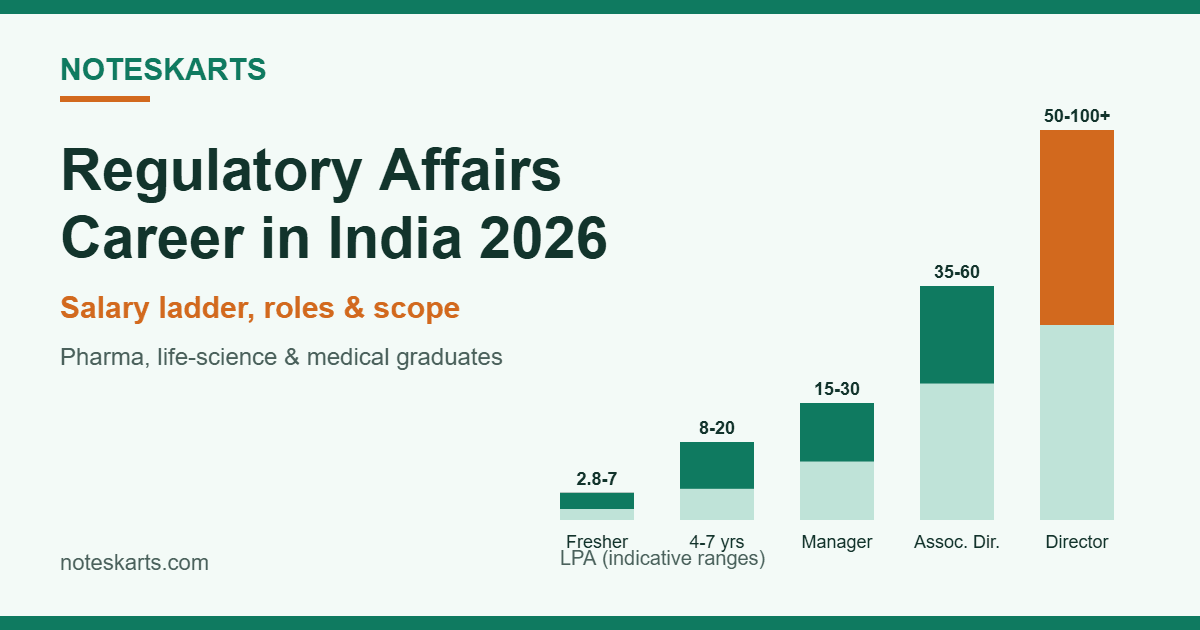
Short answer: about ₹2.8–7 LPA for freshers, rising to ₹50 LPA–₹1 crore+ for directors. Pay is good at entry and exceptional at the top. These are indicative ranges from public sources; actual pay varies by company, degree, and especially international submission experience.
Fresher salary by qualification
| Qualification | Fresher salary (per year) |
|---|---|
| B.Pharm | ₹2.8 – ₹4.5 LPA |
| M.Pharm | ₹3.5 – ₹6.0 LPA |
| Pharm.D | ₹4.0 – ₹7.0 LPA |
| Biotechnology / life sciences | ₹3.0 – ₹5.5 LPA |
Regulatory affairs salary by experience and seniority
| Level | Salary (per year) |
|---|---|
| 1 – 3 years | ₹4 – ₹10 LPA |
| 4 – 7 years | ₹8 – ₹20 LPA |
| Regulatory Affairs Manager | ₹15 – ₹30 LPA |
| Senior Manager RA | ₹25 – ₹40 LPA |
| Associate Director RA | ₹35 – ₹60 LPA |
| Director RA | ₹50 LPA – ₹1 Crore+ |
Employer type also matters: MNC pharma (₹6–30 LPA) and biotech (₹5–28 LPA) tend to pay more than Indian pharma (₹4–18 LPA). USFDA and EU submission experience typically commands the highest pay.
Key skills and tools for a regulatory affairs career
- Knowledge of USFDA, EMA, MHRA, CDSCO, TGA, and PMDA regulations.
- eCTD submission skills, plus ANDA and DMF experience for US-focused roles.
- Regulatory information systems such as Veeva Vault RIM, TrackWise, and Documentum.
- Strong technical and medical writing, attention to detail, and project management.
Scope and future of regulatory affairs in India
The outlook is strong and getting stronger, driven by:
- Rising global regulatory requirements and more complex approvals.
- Rapid growth in generics, biosimilars, and biologics, all needing heavy regulatory work.
- Simultaneous multi-country product launches, which need skilled global regulatory teams.
- Digital regulatory systems and emerging AI-assisted regulatory operations.
A fair note on AI: AI is starting to speed up regulatory writing and data checks, but approvals carry legal accountability, so trained RA professionals remain essential to review, decide, and sign off. The role is evolving, not disappearing. Upskilling keeps you ahead.
How to start a regulatory affairs career: step by step
- Confirm eligibility. A pharmacy, life-science, or medical degree works best.
- Learn the fundamentals: the drug approval process, CTD/eCTD structure, and key authorities (CDSCO, USFDA, EMA).
- Build technical writing skills and, if helpful, take a focused RA/eCTD course (choose carefully).
- Apply to entry roles, Regulatory Affairs Associate or Executive, at pharma, biotech, device, or CRO companies.
- Gain submission experience, then specialise (for example US generics/ANDA) to unlock the highest-paying roles.
Common mistakes when starting a regulatory affairs career
- Expecting director-level pay early. The crore-plus roles need many years and global filing experience.
- Paying for a course that promises a guaranteed job. No course can promise that.
- Neglecting technical writing and attention to detail, which employers test first.
- Staying only on domestic filings and never building USFDA or EU submission experience.
Regulatory affairs vs pharmacovigilance vs medical coding
All three are popular pharma career switches open to similar graduates. In short:
- Regulatory affairs: highest long-term salary ceiling; document- and compliance-heavy; great for detail-oriented planners.
- Pharmacovigilance: drug safety and case processing; steady, desk-based, good entry demand.
- Medical coding: billing codes; very accessible and remote-friendly, with a lower ceiling. Read our medical coding career in India guide.
Is a regulatory affairs career worth it?
Honestly: yes, and it has one of the best long-term payoffs in pharma. Entry salaries are reasonable, and with experience, especially global submission expertise, pay climbs steeply into manager, director, and VP roles. The work is stable, intellectually demanding, and essential.
For a pharmacy or science graduate who enjoys detail, documentation, and compliance, a regulatory affairs career is one of the smartest, highest-ceiling switches available in 2026.
Frequently asked questions about a regulatory affairs career
What is a regulatory affairs career in pharma?
Regulatory affairs (RA) ensures pharmaceutical products meet all legal and regulatory requirements before and after launch. RA professionals prepare submissions and eCTD dossiers, manage compliance, and communicate with health authorities like CDSCO, USFDA, and EMA. It is an office-based, compliance-driven career.
What is the salary of a regulatory affairs professional in India?
Freshers earn around ₹2.8–7 LPA depending on degree. With experience, pay rises to ₹8–20 LPA (4–7 years), ₹15–30 LPA (manager), and ₹50 LPA to over ₹1 crore for directors. USFDA and EU experience pays the most.
Who can make a career in regulatory affairs?
Pharmacy (B.Pharm, M.Pharm, Pharm.D), life-science (biotech, biochemistry, microbiology), and medical (MBBS, BDS, MDS) graduates are commonly eligible. Freshers usually start as a Regulatory Affairs Associate or Executive.
What skills are needed for a regulatory affairs career?
Knowledge of USFDA, EMA, and CDSCO regulations; eCTD submission skills; ANDA and DMF experience for US roles; tools like Veeva Vault RIM and TrackWise; and strong technical writing and attention to detail.
Is regulatory affairs a good career in 2026?
Yes. It offers one of the best salary ceilings in pharma, strong job security, and global growth in generics, biosimilars, and biologics. Entry pay is moderate, but senior and director roles are highly paid.
Will AI replace regulatory affairs jobs?
Not entirely. AI speeds up writing and data checks, but regulatory approvals carry legal accountability, so trained RA professionals are still needed to review and sign off. The role is evolving, and upskilling keeps you in demand.
How can a fresher start a regulatory affairs career?
Learn the drug approval process and CTD/eCTD structure, build technical writing skills, and apply for Regulatory Affairs Associate or Executive roles at pharma, biotech, device or CRO companies.
The bottom line: your regulatory affairs career path
A regulatory affairs career is one of the highest-ceiling, most secure switches a pharmacy or science graduate can make in India in 2026. Start as an associate, learn the drug-approval process and eCTD, build real submission experience, and specialise in global filings. That is the path from a modest first salary to director-level pay. The demand is strong, and the long-term reward is among the best in pharma.
Learn the approval process, sharpen your writing, get in at the associate level, and grow toward global submissions. That is how a career switch becomes a career.
Note: this article is general career guidance, not a job guarantee or an endorsement of any course or employer. Salary figures are indicative estimates that vary and change. Research providers and roles independently before paying for a course or accepting an offer.
Sources and official links
India regulatory-affairs role and salary ranges were verified against public sources in November 2026 and are indicative only. Pay and demand change. Confirm current figures before deciding. No course or certificate guarantees a job.